

The AI Revolution Is No Longer Coming — It’s Already Here
Artificial Intelligence has officially moved beyond being just another tech buzzword. In 2026, AI is transforming the global economy faster than almost any technology in modern history. From multinational corporations to small startups, everyone is racing to integrate AI into daily operations. Whether it’s AI-generated videos, automation tools, smart assistants, or AI agents replacing repetitive office work, the impact is now visible across every major industry worldwide.
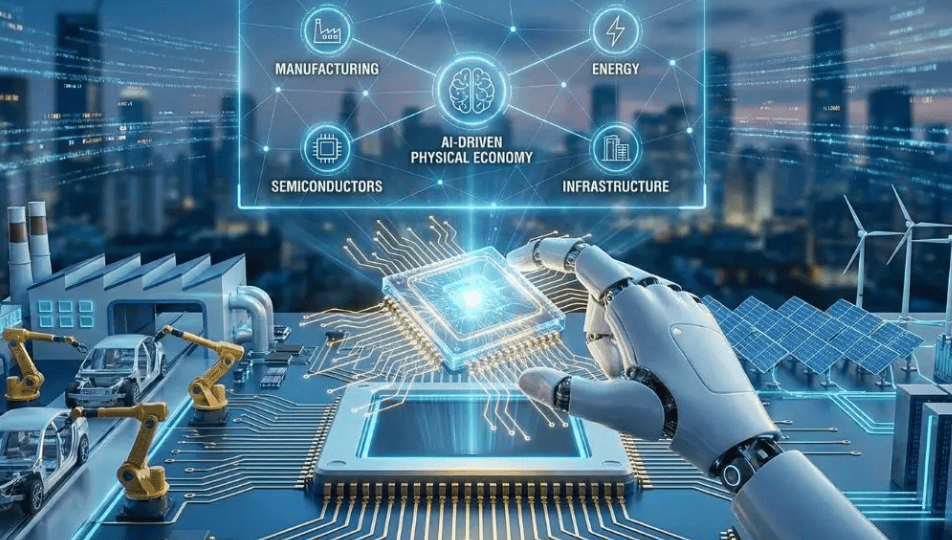
What makes this shift even bigger is the scale of investment happening globally. Governments, tech companies, and investors are pouring hundreds of billions into AI infrastructure. Companies are building massive data centers, AI chips are becoming more valuable than oil in some markets, and nations are treating AI leadership like a geopolitical battle. The conversation is no longer about whether AI will change the world. The real question now is how fast the transformation will happen.

The biggest reason AI matters economically is simple: productivity. Businesses want faster output, lower costs, and higher efficiency. AI delivers all three. A single employee using AI tools today can perform tasks that once required entire departments. That reality is creating excitement for businesses but anxiety for workers at the same time.
Why AI Became the Biggest Economic Trend of 2026
Businesses Are Adopting AI Faster Than Expected
A few years ago, companies were experimenting with AI casually. They used chatbots for customer service or AI-generated marketing copy as a side experiment. In 2026, the situation looks completely different. AI is now integrated directly into business operations. It handles research, coding, analytics, customer support, workflow automation, and even strategic planning in some companies.
Large corporations are aggressively investing because competition has become brutal. If one company automates operations with AI and another doesn’t, the difference in productivity becomes massive. Businesses fear being left behind. This pressure is pushing industries into a rapid AI adoption cycle.
Even small creators and entrepreneurs are benefiting. One-person AI businesses are becoming common online. A solo founder can now run:
- marketing campaigns
- video editing
- social media management
- content writing
- customer support
- design work
using AI-powered systems.

This is why many experts compare AI to the arrival of the internet in the late 1990s. Entire industries are being rebuilt around automation and intelligence.
The Explosion of AI Spending Worldwide
AI Investment Is Reaching Historic Levels
The amount of money flowing into AI in 2026 is staggering. Global AI spending is now measured in trillions, not billions. Tech giants like Microsoft, Google, Meta, and Amazon are investing enormous amounts into:
- AI chips
- cloud infrastructure
- AI data centers
- software ecosystems
- automation systems
The race for AI dominance has become one of the most important business competitions in history.
According to industry forecasts, worldwide AI infrastructure spending could exceed trillions over the next few years. Investors believe AI could reshape global productivity similarly to electricity or industrial machinery during earlier economic revolutions.

The infrastructure boom is also creating opportunities outside the tech sector. Construction companies, electricity providers, semiconductor manufacturers, and cybersecurity firms are all benefiting from the AI wave.
AI Is Changing the Global Job Market
Which Jobs Are Being Affected First?
One of the hottest global debates in 2026 is whether AI will replace millions of workers. The truth is complicated.
AI is already automating many repetitive digital tasks. Industries seeing major disruption include:
- customer support
- basic programming
- graphic design
- content creation
- data entry
- translation services
- administrative work
AI tools can now generate reports, summarize meetings, write emails, create videos, and analyze large datasets within seconds. Businesses naturally use these tools to save time and reduce costs.
But this doesn’t automatically mean all jobs disappear. Instead, many roles are evolving. Workers who learn AI tools are becoming significantly more productive than those who ignore them.

Many economists believe the future workplace will involve humans working alongside AI systems rather than being fully replaced by them. Creativity, emotional intelligence, leadership, and critical thinking still remain areas where humans hold strong advantages.
The Rise of AI Agents and Autonomous Work
What Are AI Agents?
AI agents are becoming one of the most disruptive technologies of 2026. Unlike simple chatbots, AI agents can complete multistep tasks autonomously.
For example, an AI agent can:
- book meetings
- respond to customer queries
- generate marketing campaigns
- research competitors
- create spreadsheets
- automate workflows
- analyze business performance
without constant human supervision.
This changes business economics dramatically. Companies can operate leaner teams while maintaining high productivity. Startups especially benefit because AI reduces operational costs significantly.
Many experts now believe AI agents could become the “digital employees” of the future economy.
The Global AI War Between Countries
USA vs China: The Biggest AI Battle
The AI race is no longer just about business profits. It has become geopolitical.
The United States and China are competing heavily for AI leadership because AI influences:
- military technology
- cybersecurity
- global trade
- digital infrastructure
- economic power
The United States currently dominates advanced AI chips and large-scale AI models. China, meanwhile, is investing aggressively in domestic AI development and smart manufacturing.
Many analysts believe the country leading AI infrastructure could dominate the next global economic era.

Other countries like India, United Arab Emirates, and several European nations are also rapidly investing to avoid falling behind.
AI Is Reshaping Major Industries
Healthcare
AI is transforming healthcare through:
- faster diagnostics
- medical imaging analysis
- drug discovery
- virtual health assistants
Hospitals are increasingly using AI systems to reduce workloads and improve patient care.
Finance
Banks use AI for:
- fraud detection
- algorithmic trading
- customer support
- risk analysis
AI systems process financial data much faster than human analysts.
Education
AI-powered learning tools are personalizing education globally. Students can now receive customized lessons, instant explanations, and adaptive learning systems.
Retail and E-Commerce
Online shopping platforms use AI for:
- recommendation systems
- customer targeting
- pricing optimization
- inventory forecasting
Retail companies using AI effectively are seeing stronger profits and higher customer engagement.

The Hidden Problem: AI Needs Massive Energy
One major challenge people rarely discuss is electricity demand.
AI systems require enormous computing power. Large AI models run inside giant data centers consuming huge amounts of energy. Experts warn the global AI boom may create electricity shortages and infrastructure pressure in some regions if demand keeps rising rapidly.
This means the AI revolution is also becoming an energy story.
Countries investing heavily in renewable power, nuclear energy, and infrastructure upgrades may gain strategic advantages in the future AI economy.
Deepfakes, Privacy, and the Dark Side of AI
AI is not creating opportunities alone. It is also creating serious risks.
Deepfake technology has improved dramatically. Fake videos, voices, and images are becoming harder to detect. This creates risks for:
- politics
- elections
- cybersecurity
- misinformation
- scams
At the same time, privacy concerns continue growing. AI systems rely heavily on massive datasets. Governments worldwide are debating regulations around AI safety and data protection.
The challenge is balancing innovation with responsibility.
Too much regulation may slow economic growth.
Too little regulation may create dangerous consequences.
Could AI Create a Bigger Wealth Divide?
One major fear among economists is that AI could increase global inequality.
Countries with advanced AI infrastructure may become dramatically richer and more powerful. Meanwhile, developing economies without strong digital systems could struggle to compete.
The same issue exists within societies. Highly skilled workers using AI effectively may see income growth, while repetitive job roles face increasing automation pressure.
This could reshape middle-class employment worldwide.
What the Future of the AI Economy Looks Like
Most experts believe AI will continue expanding aggressively through 2030 and beyond.
Future predictions include:
- AI-powered companies operating with tiny teams
- autonomous digital workers
- fully AI-generated entertainment
- AI-driven scientific discoveries
- smarter cities powered by AI infrastructure
But despite all the automation headlines, humans will still remain central to the economy. Creativity, emotional intelligence, trust, leadership, and strategy continue to matter deeply.
The future likely belongs to people who know how to work with AI instead of competing against it.
Conclusion
Artificial Intelligence is reshaping the global economy faster than most people expected. Businesses are rebuilding operations around automation, governments are competing for AI dominance, and workers are adapting to entirely new economic realities.
The AI revolution is not limited to technology companies anymore. It now affects:
- jobs
- education
- healthcare
- politics
- global trade
- energy markets
- investment flows
Some industries will struggle with disruption. Others will grow faster than ever before.
One thing is becoming clear in 2026:
AI is no longer optional for the future economy.
It is becoming the foundation of it.

FAQs
How is AI changing the global economy in 2026?
AI is improving productivity, automating business operations, changing jobs, and driving massive global investment.
Will AI replace jobs completely?
Most experts believe AI will transform jobs rather than eliminate all human workers entirely.
What are AI agents?
AI agents are autonomous systems capable of performing tasks and workflows with minimal human input.
Why are governments investing heavily in AI?
AI influences economic growth, military competitiveness, cybersecurity, and technological leadership.
Which industries are benefiting most from AI?
Healthcare, finance, retail, logistics, education, and software industries are seeing major AI-driven transformation.